While major advances in genetics, nutrition and management have improved productivity in modern aquaculture systems, a key limitation remains: the animal’s ability to maintain physiological homeostasis under challenging conditions.
Rising water temperatures, environmental variability and increasing disease pressure are driving greater inconsistency in growth, feed efficiency and survival. Under these conditions, aquaculture feeds must not only support optimal performance, but also maintain biological function when animals are challenged. However, many feeding strategies still reflect conditions that no longer match current production realities.
Increasing environmental and sanitary pressures require nutritionists to re-evaluate feed formulations to adapt and more precisely meet animal requirements under both standard and challenging conditions. It’s no longer enough to formulate diets for optimal performance under regular production conditions. Today’s aquafeeds must also support animals when intake drops, stress increases and metabolic demands shifts.
Feeding for resilience in aquaculture is not about adding more to the diet – it’s about delivering the required essential nutrients in forms animals can more efficiently utilize.
Resilience Starts with Aquaculture Nutrition
Before considering inclusion of any possible non-essential functional additive, the formulation must ensure that essential nutrient requirements are met with sufficient availability and consistency, particularly through stress events such as heat, handling or environmental shifts.
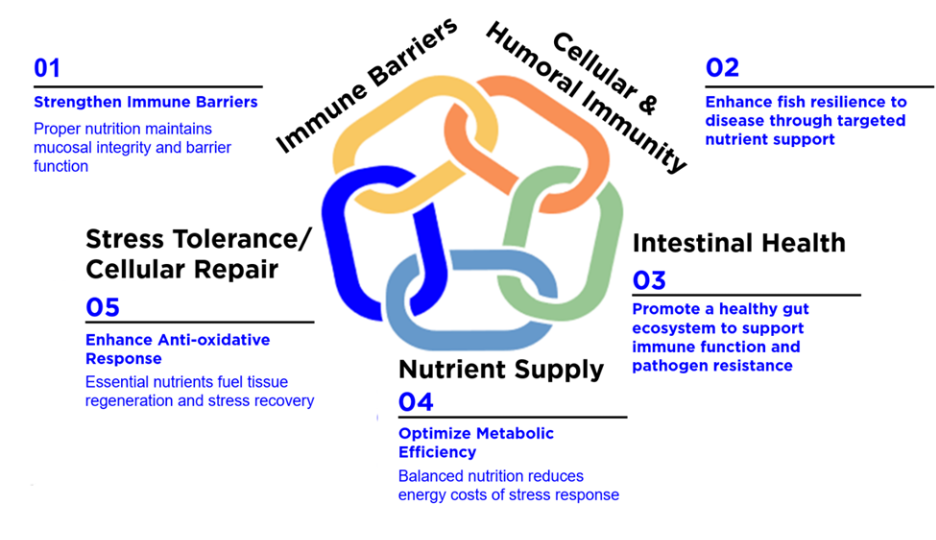
A robust nutritional strategy supports key biological systems that determine resilience by ensuring adequate availability of essential nutrients, including trace minerals. When properly optimized, mineral nutrition contributes to:
- Integrity of epithelial barriers (skin, gills and intestine), supporting first-line defense against pathogens
- Effective immune system function, including activation and regulation of immune responses
- Oxidative balance and cellular repair mechanisms, enabling recovery from stress-induced damage
- Lower energetic cost of stress responses, preserving resources for growth and immunity
- A more stable gut environment and microbiome, helping resist infections and maintain nutrient absorption
Why Trace Mineral Strategy Matters in Aquaculture Feed
Trace minerals are essential nutrients involved in hundreds of metabolic, immune and antioxidant processes. Their role is not additive, but foundational.
Yet, not all trace mineral forms are equally effective. Inorganic trace mineral sources are no longer sufficient to sustain optimal performance and health in modern aquaculture systems. At the same time, while organic trace minerals offer improved bioavailability, their efficacy is not uniform and depends strongly on their chemical structure, stability and demonstrated biological response.
This is particularly relevant under current regulatory constraints, where maximum permitted inclusion levels for trace minerals in feed are limited. These restrictions require greater precision in formulation, shifting the focus toward more bioavailable sources to ensure that animal requirements are met within legal limits. In addition, improving mineral utilization is critical to reduce excretion into the environment, supporting both production efficiency and sustainability goals.
Reduced ingredient flexibility narrows the margin for error in feed formulation. Investing in more bioavailable trace minerals can elevate the performance of the feed formulation, before non-essential additives are included, helping protect margins by getting more value out of every ton produced.
Meeting the animal’s requirement for bioavailable trace minerals is a prerequisite for resilience, not an optional enhancement.
Zinpro® Performance Minerals® are a proven solution used across the global aquaculture industry to support nutrient utilization and performance consistency.
Supporting Fish Through Feed Intake and Stress Challenges
Feed intake responses to environmental stress are dynamic and not unidirectional. While a sustained stress response is typically associated with reduced feed intake, elevated temperatures can initially stimulate increased feed consumption, driven by higher metabolic rates. However, this short-term increase in intake is often accompanied by reduced feed efficiency, as nutrient utilization becomes less efficient and maintenance energy requirements rise, ultimately leading to poorer feed conversion ratios.
As stress persists or intensifies, feed intake generally declines, creating a nutritional bottleneck where physiological demands increase while nutrient supply decreases.
These contrasting phases present a common formulation challenge: ensuring that nutrients are both sufficiently available during periods of increased intake but also highly bioavailable when intake becomes limiting. Under both scenarios, fish must efficiently utilize nutrients to:
- Maintain immune competence
- Preserve skin health and gut integrity and function
- Support recovery and tissue repair
At the same time, stress-related disruptions in digestion and gut microbiota can further compromise nutrient absorption. This reinforces the importance of nutrient density and bioavailability within the base diet, particularly for essential nutrients such as trace minerals.
Building Resilience from the Foundation
By refining your trace mineral strategy, you can strengthen the foundation of the entire formula, helping maintain performance under stress, improve feed efficiency and better support customers facing increasingly unpredictable production conditions.
Explore how Zinpro Performance Minerals can help you build a more resilient approach to aquaculture nutrition.
FAQ