
What does the modern bird really need, and how can we be more precise and avoid nutrient losses? The second edition of the Zinpro® Global Poultry Mineral Guide is here to help, backed by science-based recommendations for different sub-species, challenges and production phases.
At Zinpro, more than 100 poultry scientific studies and 400 peer-reviewed publications across all species have contributed to updating trace mineral recommendations for different poultry species and production goals. This research culminated in the launch of the first edition of the Zinpro Global Poultry Mineral Guide in 2024, used by hundreds of industry experts worldwide.
But the past two years have brought even more new insights around mineral nutrition.
Phytase Super Dosing
We have a growing understanding of trace mineral nutrition and the impact of super dosing (efficient) phytase in poultry diets.
Continued Genetic Progress
Continued genetic progress is making birds even more efficient, including in trace mineral uptake and retention, and different genetic lines.
Growth and Heat Stress
High growth rates and factors such as heat stress also put more pressure on gut health, metabolism and nutrient turnover, which could hinder the efficient uptake of macro and micronutrients.
Organic Trace Mineral Source
The industry is moving toward a more refined approach to trace mineral nutrition, which includes replacing inorganic sources with a fully organic trace mineral source.
What’s New in the Updated Guide?
Understanding the changing needs of modern genetic lines, together with the latest insights generated by Zinpro research, has led us to further refine recommendations and launch the second edition of the Zinpro Global Poultry Mineral Guide. This includes updates to several trace mineral recommendations (ppm), with adjustments to total trace mineral levels in some cases.
Each sub-species section includes Zinpro General Recommendations with additional focus areas such as Food Safety, Infectious Disease Challenges and more. Under these areas, changes from the general recommendations are highlighted to make it easy to identify where a trace mineral recommendation has been adjusted. Here is a glimpse of some of the key updates:
| Zinc (Zn) | 1st Edition (2024) | 2nd Edition (2026) | Change |
|---|---|---|---|
| Total | 100ppm | 90ppm | ↓ 10 ppm |
| Inorganic | 60ppm | 50ppm | ↓ 10 ppm |
Infectious Diseases / BCO Lameness Challenges / ABF Diets
The recommendations for Zinc (Zn), Manganese (Mn) and Copper (Cu) are adjusted compared to the General Recommendations.
Less Inorganic, Rebalanced Contributions
The recommended contributions of Zinpro and inorganic trace minerals shifted to account for a decrease in inorganic trace minerals, as is recommended by Zinpro-backed research. For example, within Layers | Zinpro General Recommendations, pullets are now recommended to decrease inorganics as compared to the 2024 recommendations.
Updated Genetic Breeder Lines
Aviagen, Cobb and Hubbard are featured for broilers and breeders, along with genetic breeder lines for commercial layers and turkeys.
Zinpro® Sole Source™ / Sustainability
New recommendations focused on complete elimination of inorganic trace mineral sources from the birds’ diets, supported by inclusion of phytase enzyme in the formulations.
Supporting Evolving Demands in Poultry
Besides the refinement in recommendations, Zinpro has built the scientific foundation for a complete organic trace mineral program (Zinpro Sole Source), which is now an important part of the Zinpro mineral recommendations.
This addition reflects the evolving needs of the global poultry industry, where nutrition programs increasingly prioritize sustainability, bird wellbeing and food safety. It also highlights the Zinpro commitment to continuously refining trace mineral nutrition to help customers meet these evolving demands.
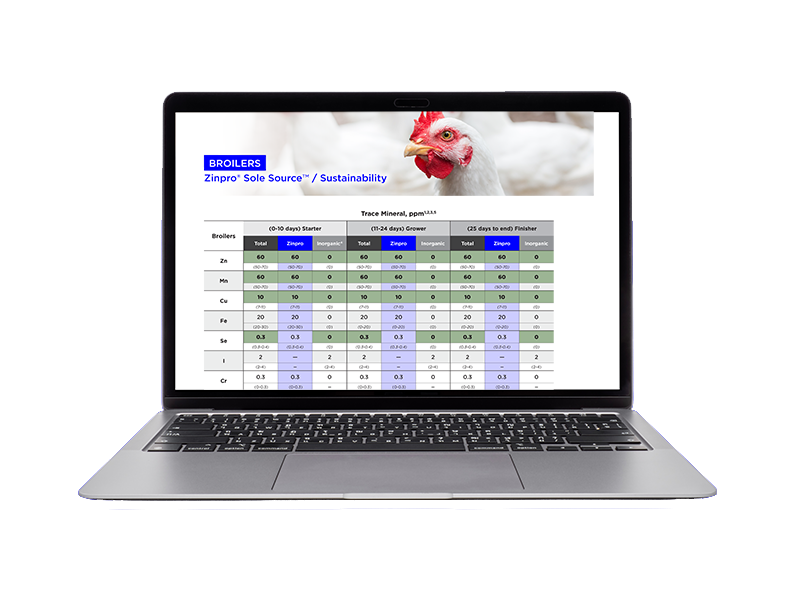
Download the Zinpro Global Poultry Mineral Guide
Second-edition trace mineral recommendations by sub-species, production phase and challenge.
Download the GuideContact your Zinpro Poultry Expert to uncover how trace minerals connect to bird performance, sustainability, food safety and economics on your farm.
Frequently Asked Questions